I got off the Marker waitlist on a Saturday and planned to poke at it for an hour. It’s a writing tool built by a small team in London that deliberately won’t write for you, which sounds like a limitation until you use it, and what it does instead is read what you’ve written and ask you questions about it. I’ve spent a number of sessions with it now across about two weeks.
You start a new document and it asks where you want to begin, with four options:
- Blank Page, which is what it sounds like.
- Existing Draft, for something you’ve already written, either by import or the classic copy and paste.
- Ramble, where you talk out loud and it turns the transcript into an outline.
- Workshop, a back-and-forth conversation about an idea before you’ve written anything.
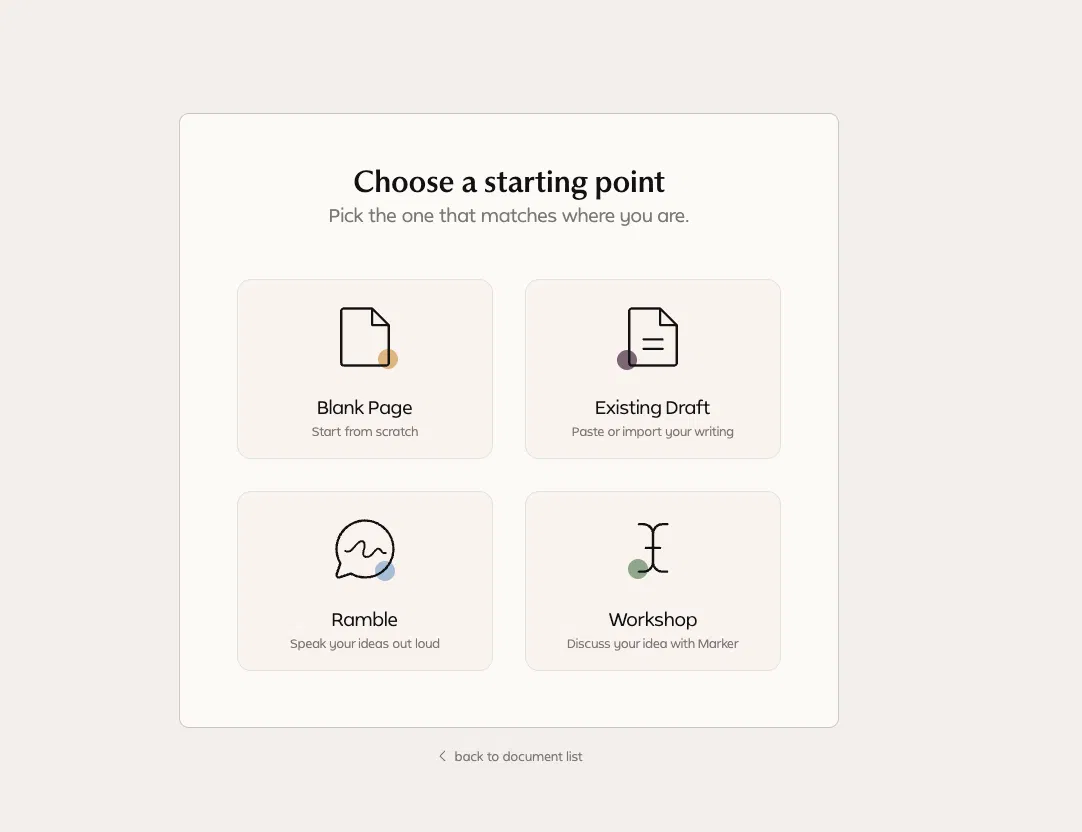
I used all four, though Blank Page is really just an empty document with the same tools sitting alongside it.
I pasted in a paragraph from a work piece I wasn’t happy with and thought needed rewriting. There’s a yellow dot next to every paragraph, and clicking it opens the Editor on that specific passage. It came back saying the passage shifted between two separate risks without showing how they connected, and asked whether I was arguing the approach was fundamentally flawed or just incomplete. I pushed back on one of its suggestions, it worked out which word was causing the confusion, and offered a swap I took. Then I read the whole thing again and decided what I’d had was fine.
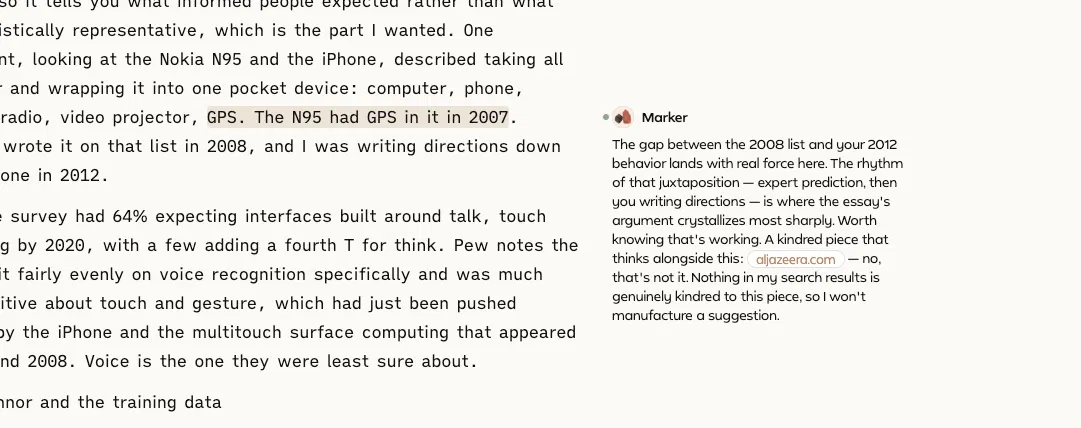
It leaves comments in the margin as it reads, and one of them on a different piece started to point me at a related article and named a site, then stopped mid-comment. “Nothing in its search results was genuinely kindred to the piece” it said, so it wouldn’t manufacture a suggestion. I’ve not had an AI tool talk itself out of an answer in front of me before. You can also point it at a whole piece instead of a paragraph, which gets you a set of margin comments and questions to work through rather than a verdict.
Workshop works the same way, which is to say it asks rather than tells. It keeps a notes panel down the side that fills up as you talk, and what goes in there is a distilled version of what you’ve said rather than a transcript, so you’re reading your own half-formed thinking written back at you in shorter words. It searched the web when I asked it to and not before, which I flagged at the time as a gap and now think was the right call.
There’s also a set of one-click tools that run on their own with no conversation attached:
- Fact check, which goes through your claims and tells you which it can’t verify.
- Prep for publication, a tidy-up before you post, so titles, section breaks and proofreading.
- Strengthen argument flow, which looks at whether the reasoning holds together.
- Refine tonal consistency, which looks at whether the voice wanders.
Running prep for publication on a 900-word blog post got me a pull quote and a matched pair of section headings, which is competent general advice and wrong for how I write, so I left them. The argument-flow pass did better, catching my final sentence reading as a verdict rather than an observation, and suggesting a hedge that I took. Then four minutes later the tonal pass flagged that same hedge as sounding unsure. The fact check found a claim it couldn’t verify against public documentation and asked me about it, and when I said the number came from my own testing it closed the check there. I had tested it, so it was right, but it stopped at what I’d said rather than at anything it could look up.
Ramble is the voice option and I talked at the browser for ten minutes about old laptops and phones. It came back with an outline, a set of notes in my own words, and three sources it had gone and found on its own, including checking two dates I’d said out loud I wasn’t sure about. It also marked one of my claims as needing a check rather than tidying it into something that sounded settled, and when I went and checked that one it turned out to be wrong and came out of the piece. That ramble is where What the Phone in My Pocket Used to Be started.
I’m running this piece through Marker before it goes out, which seems only fair. It’s the first writing tool in a while where I’ve wanted to know what the next version does, and there’s a fair amount of it I still haven’t used.