Somebody asked me at training how I keep my notes, and I told them I nearly paid for an app back in May and then went and built a simple system myself instead.
I’d been keeping notes for about two years by then. First in BJJ Notes app, which I started using in Canada in my first year. I just stayed on the free tier because I wasn’t going to run a subscription to store a paragraph about where I should have my knees. At that point everything went into Google Keep and so it sat in with the shopping and other stray thoughts. Neither of them worked and it wasn’t really the apps’ fault.

The notes only matter when they help with what happens on the mat.
Take passing butterfly guard, which is somebody sitting up with both feet hooked under your thighs, kind of like sitting on a stool and using your legs as the armrests. My note on it said to pull their knees and stand up, which is a real pass and it does work. However there are multiple versions and only one will work, depends on what the other person is doing at the time.
So I built it in Notion instead, with a Claude project sitting in front of it. I paste a rough note into Claude, sometimes a couple of lines, sometimes a mess, and it goes and finds a matching entry. It tells me whether it’s appending or creating before it does it, fills the gaps using my note as the source, and flags it when something contradicts an older note. That last bit is the one I’d point at if you’re thinking of doing this yourself, because what I actually had was about two years of me contradicting myself and I hadn’t noticed.
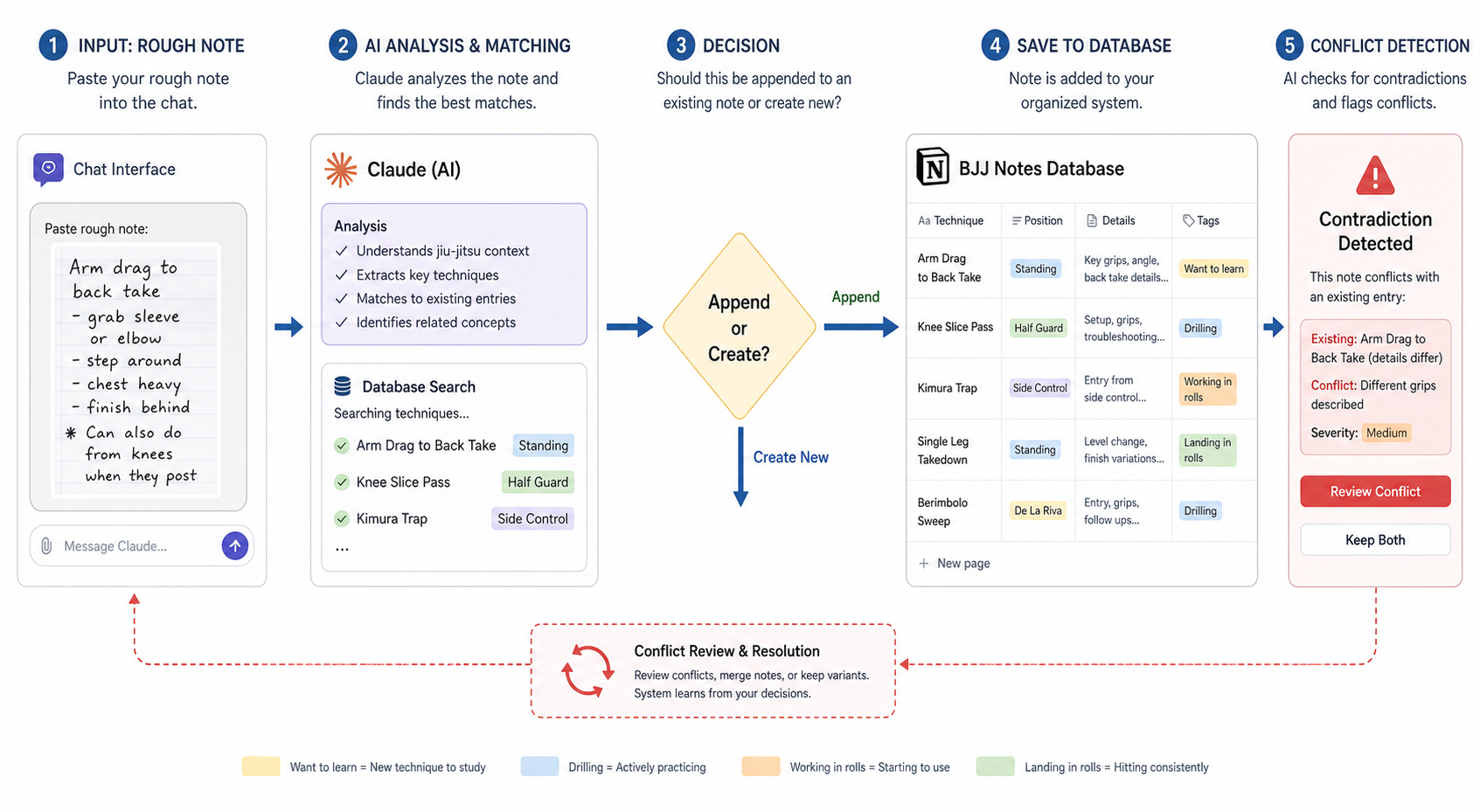
The useful part is not storing another note. It is finding where the note belongs and noticing when it disagrees with what is already there.
I should probably be straight about the trade as well. I didn’t want the subscription and so now Notion has my training log and Anthropic has seen every rough note I’ve pasted in, which is obviously more than the app would have taken off me. It’s jiu-jitsu so I’m not really bothered either way, though I’d think differently about anything with work in it, and I mean I’ve seen enough of these tools change their terms to not assume today’s arrangement is permanent.
The Google Keep pile came over the same way, and that was a year of putting it off. Three word notes, four paragraph notes typed on a phone after a heavy session, no order to any of it. Sorting existing material into a structure is dull and mechanical and I can check it afterwards, and so it’s the sort of job worth handing over.
The shape of it is the part no app was going to do for me. Entries are written as reads, and so butterfly is three passes keyed to what the other person does. A failed pass links on to where you actually end up, and so butterfly goes to half guard, and half guard goes to the knee cut and to recovering guard. Statuses run want to learn, drilling, working in rolls, landing in rolls, with a drop-off for the ones I’ve given up on.
The bit I’d actually tell someone about is what happened once I had landed one of them. I’ve caught the jump-over a few times now against people who pushed into me. The first time somebody gets caught by something the surprise is most of why it worked, and the second time there’s no surprise, so they push differently or they don’t push at all, and then I need the variation I’ve barely drilled. In my case that’s why you want the whole tree written down and not the one pass that worked on a Tuesday.
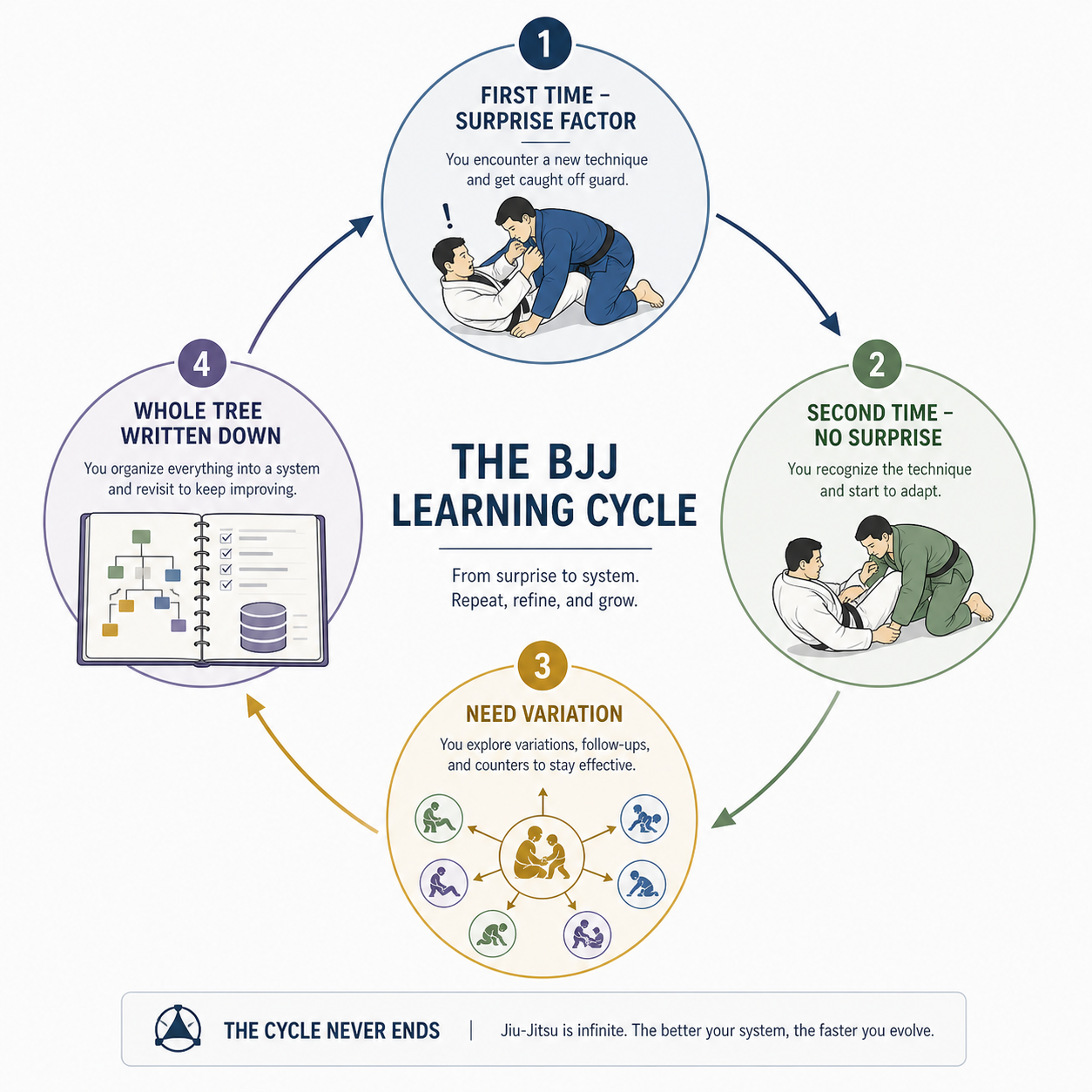
The first success exposes the next thing to learn once the surprise has gone.
My advice to anyone building one of these would be to work out first which half of the problem you’ve actually got, because the software half is the easy one.